徐国建博士在HCCH研讨会演讲(附英文演讲稿)
- 2026-11-21 17:33:03

编者按:
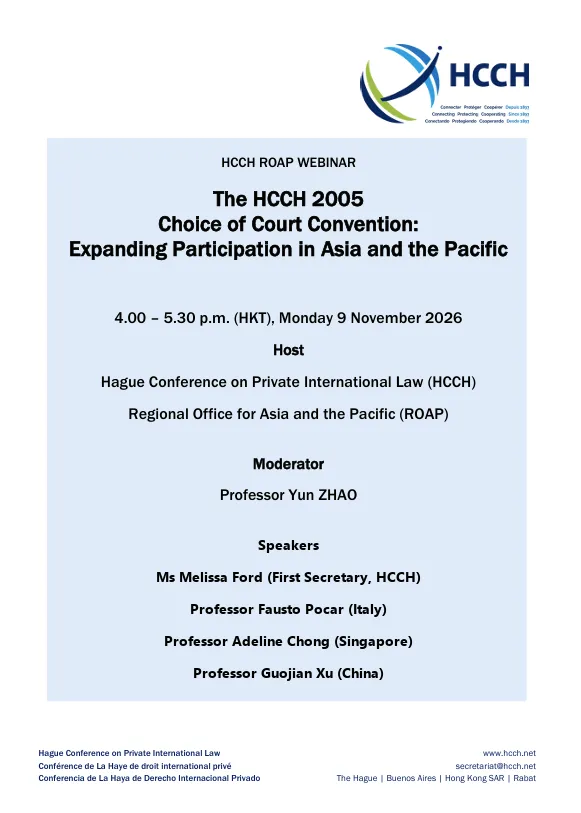
海牙国际私法会议亚太区域办事处(HCCH‑ROAP)于2026年11月9日主办了题为《2005 年〈选择法院协议公约〉:扩大亚太地区参与度》(The HCCH 2005 Choice of Court Convention: Expanding Participation in the Asia Pacific)线上研讨会。本次研讨会邀请来自海牙国际私法会议常设局、欧洲、新加坡以及中国等多地国际私法领域专家学者,围绕公约概况、欧洲实践经验、亚太司法视角以及中国的签署与批准进程等议题展开分享与研讨。
徐国建博士受邀参会,并作题为《公约与中国:从签署到批准》(The Convention and China: from Signature to Ratification)的主题分享。现将其英文演讲稿刊发如下,供参考交流。

The 2005 HCCH Choice of Court Convention and China: From Signature to Ratification
Professor Guojian XU
Distinguished Dean & Professor, School of International Law
Shanghai University of Political Science and Law
Good afternoon, everyone.
It is a great pleasure to join this HCCH webinar.
Today, I would like to discuss the relationship between China and the 2005 HCCH Convention on Choice of Court Agreements, which I will refer to simply as “the Convention.”
My presentation has a relatively simple structure. First, I will briefly explain where China currently stands in relation to the Convention and how ratification works under Chinese law. Second, I will examine China’s current legal framework for the recognition and enforcement of foreign judgments, particularly under the revised Civil Procedure Law. And finally, I will compare that framework with the Convention and explain why, in my view, there is no fundamental legal incompatibility between the Convention and the current Chinese regime.
My conclusion is that the remaining question for China is not whether the Convention is fundamentally compatible with Chinese law. Rather, it is principally a matter of treaty approval, policy assessment and implementation.
I. China and the Convention:
Current Status
Let me begin with the current status.
China signed the Convention of 30 June 2005 on Choice of Court Agreements on 12 September 2017. However, China has not yet deposited an instrument of ratification, and therefore the Convention has not yet entered into force for China. This is important because the Convention is not simply a jurisdictional instrument.
It establishes a broader and coherent framework concerning three closely connected issues: first, the effectiveness of exclusive choice of court agreements; second, the jurisdiction of the chosen court; and third, the recognition and enforcement of judgments resulting from proceedings before that court.
In other words, the Convention seeks to give commercial parties greater confidence that, when they agree on a particular court, their agreement will be respected and that the resulting judgment will have a meaningful prospect of recognition and enforcement abroad. For international commerce, that predictability is particularly important.
II. How Ratification Works
under Chinese Law
Let me now turn to the domestic procedure.
Under Article 7 of the Law of the People's Republic of China on the Procedure for the Conclusion of Treaties, the ratification of treaties follows a constitutionally and institutionally defined process.
In simplified terms, there are three principal stages. First, after signature, the treaty is submitted by the Ministry of Foreign Affairs, or by the relevant department of the State Council together with the Ministry of Foreign Affairs, to the State Council for examination. Second, where ratification is required, the matter is submitted to the Standing Committee of the National People's Congress, which makes the decision on ratification. Third, following that decision, the President of the People's Republic of China ratifies the treaty.
So, signature and ratification are legally distinct stages. China's signature in 2017 demonstrates its participation in the Convention-making process and its political commitment to the Convention, but it does not by itself make the Convention binding upon China as a Contracting State.
III. Is There a Fundamental
Legal Obstacle?
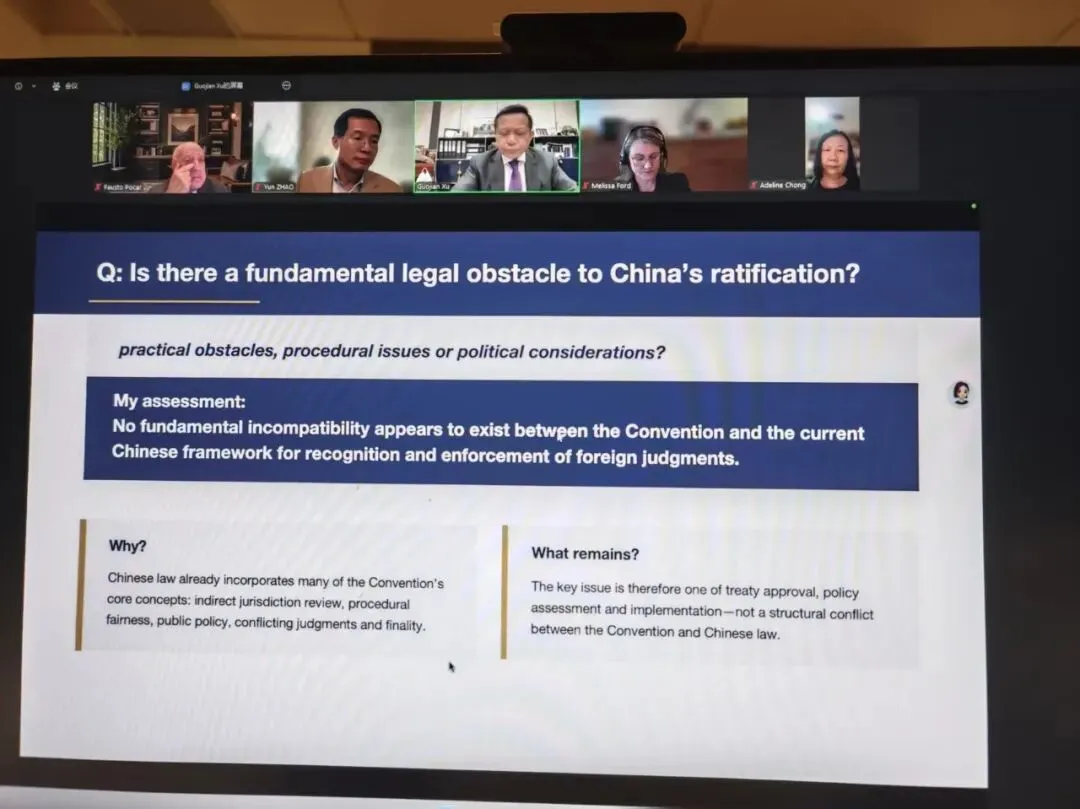
This brings me to what I consider the central question of today's presentation: Is there a fundamental legal incompatibility between the 2005 Convention and China's current legal framework?
My assessment is no.
I do not see a fundamental conflict between the Convention and China's current rules governing the recognition and enforcement of foreign judgments. This conclusion is particularly significant because China's legal framework has developed considerably since 2017. The 2023 revision of the Civil Procedure Law of China introduced a more systematic framework for the recognition and enforcement of foreign judgments, including provisions dealing with jurisdiction, procedural fairness, conflicting judgments, parallel proceedings and reconsideration.
Many of these concepts substantially overlap with the architecture of the 2005 Convention. So, rather than asking whether China would have to completely redesign its existing system in order to implement the Convention, I believe the more appropriate question is: How can China's existing framework be coordinated with the Convention once China decides to complete the ratification process?
Let me briefly explain why.
IV. China's Current Framework
for Foreign Judgments
The starting point is Articles 298 to 303 of the Civil Procedure Law of China. I will not go through each provision in detail. Instead, I would like to highlight the main features.
First, access to recognition and enforcement. Under Article 298, a party may apply directly to the competent Chinese people's court for recognition and enforcement of an effective foreign judgment or ruling. Recognition and enforcement may also be sought through an applicable international treaty or, where appropriate, on the basis of reciprocity. Thus, Chinese law already provides a clear judicial mechanism for giving effect to foreign judgments.
Second, the review is not a retrial on the merits. The Chinese court examines whether the statutory or treaty requirements for recognition and enforcement have been satisfied. It does not ordinarily reopen the substantive dispute and reconsider the merits simply because the foreign judgment was reached under a different legal system. This is an important point of convergence with the Convention.
Third, Chinese law provides a set of grounds on which recognition or enforcement may be refused. These include, in substance, jurisdictional defects, serious procedural deficiencies, fraud, conflicts with existing judgments, and fundamental public policy concerns. I will not enumerate all of these grounds today. The important point is that the Chinese system already operates through a structured review of jurisdiction, due process, integrity of the judgment, conflicting judgments and public policy.
That is highly relevant when we compare Chinese law with the 2005 Convention.
V. Indirect Jurisdiction:
An Important Point of Convergence
One particularly interesting area is indirect jurisdiction. Under Article 301 of the Civil Procedure Law of China, when a Chinese court considers whether to recognize a foreign judgment, it may examine whether the foreign court had an appropriate jurisdictional basis.
The Chinese rules take into account, among other things, the foreign court's jurisdiction under its own law, the existence of an appropriate connection with the dispute, Chinese rules on exclusive jurisdiction, and the parties' exclusive choice of court agreement. This is significant because jurisdiction is also at the heart of the 2005 Convention.
The Convention establishes a framework under which an exclusive choice of court agreement determines the jurisdictional relationship between the parties and the chosen court, while the requested State may examine whether the Convention's requirements have been satisfied when recognition and enforcement are sought.
The terminology and detailed mechanisms are not identical. But the underlying objective is similar: a judgment should not ordinarily be recognized if it was rendered by a court that was not entitled to adjudicate the dispute under the applicable jurisdictional framework.
This is one of the strongest examples of functional convergence between the two regimes.
VI. The Convention's Recognition-
and-Enforcement Framework
Let me now look briefly at the Convention itself.
Article 8 establishes the basic obligation concerning recognition and enforcement of judgments rendered by a court designated in an exclusive choice of court agreement. At the same time, the Convention makes clear that recognition and enforcement are subject to certain conditions and exceptions.
An important principle is that the requested court should not re-litigate the merits of the foreign judgment. This reflects a basic philosophy of international judicial cooperation: the court requested to recognize a foreign judgment is not being asked to act as a second-instance appellate court. Instead, it is asked to determine whether the judgment satisfies the Convention's requirements for recognition and enforcement.
Article 9 then provides the principal grounds on which recognition or enforcement may be refused. Again, without going through each ground, the overall structure is familiar to Chinese lawyers: questions concerning the validity of the choice of court agreement, procedural fairness, fraud, conflicting judgments and public policy.
This does not mean that the two systems are identical. They are not. The Convention establishes an autonomous treaty-based regime, whereas Chinese law operates through domestic legislation, judicial practice, applicable treaties and, where appropriate, reciprocity.
But the important point is that their basic legal logic is substantially compatible.
VII. A Particularly Interesting
Example: Separability
There is another issue that I believe deserves brief mention: the separability of the choice of court agreement.
Article 3(5) of the Convention provides, in substance, that an exclusive choice of court agreement forming part of a contract is treated as independent from the other terms of the contract. Therefore, the validity of the main contract does not automatically determine the validity of the jurisdiction agreement. This principle is familiar in international arbitration through the doctrine of separability of arbitration agreements.
Chinese law also recognizes a degree of independence between jurisdiction agreements and the underlying contractual relationship, through the Civil Code, the Civil Procedure Law and judicial practice. Again, I would not suggest that the two regimes are completely identical. But this example illustrates a broader point: the conceptual foundations of the Convention are not foreign to the Chinese legal system.
VIII. The Broader Pattern
of Convergence
If we step back from the individual provisions, I believe we can identify several areas of substantial convergence.
Both systems attach importance to: party autonomy and party-driven access to recognition and enforcement; finality or effectiveness of the judgment in the State of origin; procedural fairness and the right to be heard; jurisdictional control; fraud and conflicting judgments; and public policy as a safeguard.
Both systems also seek to prevent recognition and enforcement from becoming a disguised retrial of the underlying dispute. These similarities are important because they show that the Convention does not require China to move from one completely different legal model to another.
Rather, there is already a significant degree of functional convergence. And I would emphasize one qualification here. The appropriate conclusion is not “identity.” Chinese law and the Convention remain different legal regimes, with different sources, structures and detailed requirements.
The better conclusion is: substantial compatibility and functional convergence. I believe this is the more accurate way to describe the relationship between the two systems.
IX. Why the Convention
Matters for China
Why, then, would ratification matter for China?
In my view, there are at least three broader considerations.
First, China's international commercial activity has expanded enormously. Chinese companies increasingly participate in cross-border transactions, investment projects and international supply chains. For these businesses, the ability to agree in advance on a reliable forum, and to obtain recognition and enforcement of the resulting judgment abroad, is an important element of legal certainty.
Second, the Convention supports the broader objective of improving the international circulation of judgments. International commerce does not end when a court issues a judgment. A judgment has practical value only if it can ultimately be recognized and, where necessary, enforced in another jurisdiction.
Third, ratification would be consistent with China's continuing development of a foreign-related rule-of-law system and its broader participation in international legal cooperation. China has been an active participant in the work of the HCCH for many years. The Convention itself was developed with the participation of China and other major commercial jurisdictions.
From this perspective, completing the ratification process could further strengthen China's participation in the multilateral framework for international jurisdiction and judicial cooperation.
X. My Overall Assessment
Let me now bring these points together.
China signed the 2005 Convention in 2017, but the domestic ratification process has not yet been completed. Under Chinese constitutional and treaty law, ratification involves a defined institutional procedure, including examination by the State Council, a decision by the NPC Standing Committee, and ratification and deposit through the prescribed channels.
From the substantive perspective, however, China's current legal framework for foreign judgments already contains many principles that are closely aligned with the Convention. The 2023 revision of the Civil Procedure Law has further strengthened this framework. The Chinese rules address jurisdiction, procedural fairness, finality, conflicting judgments, public policy and the prevention of re-litigation of the merits. The 2005 Convention addresses many of the same concerns within its own autonomous treaty framework.
Therefore, I do not see a fundamental legal-rule conflict that would prevent China from ratifying the Convention.
Of course, ratification would still require careful consideration of declarations, reservations, implementing arrangements and the practical coordination between the Convention and Chinese procedural law.
Those are important questions. But they are questions of implementation and coordination, rather than evidence of a fundamental incompatibility between the Convention and Chinese law.
The remaining question is ultimately whether and when China will complete the domestic approval process and move from signature to ratification.
In my view, such a step would not only strengthen the Convention's global reach, but could also contribute to greater predictability in cross-border commercial dispute resolution and to the international circulation of judgments.
Thank you very much for your attention.
(Shanghai, 9 November, 2026)

简 介
该专业团队组建于1995年,拥有三十多年的跨国法律服务经验。团队创始人徐国建博士1980年进入西南政法大学攻读法律专业,1986年考取武汉大学国际私法博士研究生,后留学瑞士、荷兰等国,并于1994年获得德国汉堡大学法学博士学位,具有深厚的跨国法律专业理论素养,也同时具备丰富的跨国法律实务经验。他系上海中联律师事务所高级合伙人,同时兼任上海政法学院国际法学院特聘院长、教授,中国国际私法学会副会长,并担任中国贸仲、上仲、上国仲、北仲等知名仲裁机构仲裁员。徐博士曾多次受国务院委派作为中国代表团成员参加2005年海牙《选择法院协议公约》和2019年《承认与执行外国民商事判决公约》的谈判和公约签署的海牙外交大会。
团队长期深耕国际商事争议解决和跨境投资并购等领域,在徐博士的主导下迄今完成了众多在国内外具有良好影响的前沿法律服务项目,深得中外客户信任和赞许。团队成员均具有海内外知名院校教育背景,具备国际化视野,对跨国和跨法域复杂法律事务具有丰富的法律实务经验。
联系我们
Email:lei.yang@sgla.com
Wechat: 13601941708
往期推荐

